Google Scholar h-index
Full Publication List: Here
Publication Highlights:
Lahsen, M. (2024). “Media Reform as Transformation Tool: A Hegemonic Gap in Environmental Research and Policy.” International Journal of Politics, Culture, and Society.
Sustainability researchers are writing much about levers for transformations towards sustainability but too little about the most powerful means available for obstructing and activating them: mass-reaching media systems. How media systems are structured and governed form a profoundly important meta-level layer of decision making that ought to be central in the study of environmental politics and in environmental policy making. A politics- and media-focused account of the rise of Jair Bolsonaro to the presidency of Brazil illustrates the essential role of media systems and the need for new principles, structures, and policies for their governance if the interlinked goals of democracy, equity, and environmental protection are to be achieved. The pervasive inattention to this in environmental research reinforces hegemonic forces and needs to be widely discussed, understood, and overcome to achieve much needed just transformations towards sustainability.
Lahsen, Myanna. 2024. Steering Signification for Sustainability. Global Sustainability.
Central, powerful influences on societal knowledge, values and behavior, artificial intelligence-infused media systems, new and old, currently tend to reinforce the interlinked problems of inequality and unsustainable consumption. This problem is rarely addressed in environmental research and policy. Discussing this consequential blind spot and the power structures that underpin it, this article argues that sustainability researchers should centrally explore the need and possibilities for democratic reconfiguration of the political economies and charters of media systems to achieve sustainability and other broad, inclusive public goals.
Lahsen, M. (2024). We Cannot Afford Not to Perform Constructionist Studies of Mainstream Climate Science. In Z. Baker, T. Law, M. Vardy, & S. Zehr (Eds.), Climate, Science and Society (pp. 29-38). Routledge.
In step with the rise of the anti-environmental movement, however, concerns about technocracy were increasingly overshadowed by concerns to protect the environment and, thus, public trust in the scientific knowledge conveying the problem of continued patterns of pollution and resource use. In a context of growing “anti-science” bent on weakening environmental policy, researchers grew less inclined to support and produce constructionist studies of mainstream climate science. I illustrate these trends and discuss the implications of this “omission strategy” for science and environmental policy, drawing from my own work and experiences. My answer to the question of whether we can afford to perform constructionist studies of mainstream climate science is that we cannot afford not to perform them, and that the omission strategy is dangerous.
M. Lahsen. 2022.“Evaluating the Computational (“Big Data”) Turn in Studies of Media Coverage of Climate Change.” Wiley Interdisciplinary Reviews: Climate Change, Vol. 13 Issue 2 Pages e752, http://dx.doi.org/10.1002/wcc.752
Machine-assisted big data (MABD) research is enabling quantitative studies of large-scale social phenomena, including societal responses to climate change. The rise of machine-assisted big data science is causing both enthusiasm and concerns, and its quality and contributions depend on avoiding common pitfalls. This article reviews prominent criticisms and examines their relevance for machine-assisted big data studies exploring how macro-structural factors shape media coverage of climate change. It focuses specifically on such studies’ attempts to identify and make sense of correlations – or lack thereof – between climate vulnerability and climate coverage in different countries. The review draws on insights from a single, nationally focused, context-attentive and relatively more qualitative “small data” study in the Global South (Brazil) to shed critical light on assumptions and claims and policy recommendations made on the basis of the computer-assisted macro-studies. The review illustrates why more narrowly focused and qualitative small data studies are complementary and indispensable. Besides providing vital understanding of causal relationships that elude studies, more narrowly focused and context-sensitive qualitative studies serve to identify and understanding the consequential mediating roles of meaning-making and political strategizing in how climate and weather is framed and covered in mass media in particular places – dimensions that escape the Big Data quantitative methods and are vital to sound policy advice.
M. Lahsen, Jesse Ribot. 2021. “Politics of Attributing Extreme Events and Disasters to Climate Change.” Wiley’s Interdisciplinary Reviews: Climate Change, Vol. 13 Issue 1, e750. https://wires.onlinelibrary.wiley.com/doi/full/10.1002/wcc.750
Attribution of extreme events and disasters to climate change is often viewed as a means of stimulating climate mitigation and adaptation. Yet emphasizing climate as cause can also be ineffective or even counterproductive for stimulating climate action. Focusing on climate change as the cause of weather events can be out of synch with local political priorities and needs. Focus on climate as the cause of disasters can be misleading, since disasters are caused by pre-existing vulnerabilities on the ground that are generated by structures of inequality or faulty governance. Thus, politicians may want to blame crises on climate change, while affected populations may prefer to hold government accountable for inadequate investments in flood or drought prevention and precarious living conditions. Analytic frames that attribute disaster to climate can divert attention from these place-based vulnerabilities. Literature and case studies that we review underscore that communications about the role of climate change in extreme events and in subsequent disasters should show sensitivity to a) the political meanings and particularities of policy contexts, and b) the assumptions implicit within analytic frames about the causes of disasters, since both shape public and policy responses. Even scientifically rigorous attributions have political implications and uses, along with implicit normative assumptions. Depending on the frame of analysis, they also may not reflect local experience, politics, policy opportunities and justifiable competing priorities. Indeed, climate-centric framings of extreme events and disasters may, in some places, backfire on the noble policy purposes of stimulating climate action or preventing crises.
Lahsen, M., Esther Turnhout. 2021. “How Norms, Needs, and Power in Science Obstruct Transformations Towards Sustainability.” 16(2): 025008 Environmental Research Letters. https://doi.org/10.1088/1748-9326/abdcf0.
After decades of inadequate responses to scientists’ warnings about global environmental threats, leading analysts of the science-policy interface are seeking an important shift of research focus. This switch is from continued modeling and diagnoses of biogeochemical conditions in favor of enhanced efforts to understand the many socio-political obstacles to achieving just transformations towards sustainability, and how to overcome them. We discuss why this shift continues to prove elusive. We argue that rarely analyzed mutually reinforcing power structures, interests, needs, and norms within the institutions of global environmental change science obstruct rethinking and reform. The blockage created by these countervailing forces are shielded from scrutiny and change through retreats behind shields of neutrality and objectivity, stoked and legitimated by fears of losing scientific authority. These responses are maladaptive, however, since transparency and reflexivity are essential for rethinking and reform, even in contexts marked by anti-environmentalism. We therefore urge greater openness, self-critique, and power-sharing across research committees, to create spaces and support for conversations, diverse knowledges, and decisions conducive to sustainability transformations.
M. Lahsen. 2020. AI for Sustainability: Can and should AI be designed to save us from ourselves? IEEE Technology and Society Magazine 39, 60-67.
While mainstream academia highlights the importance of public mobilization for transformative policies, it fails to acknowledge that transformative change requires interventions in the political economy of traditional and new, AI-infused mass media, as these are inherently infused with values and used to serve political goals. Recognition of this should spur action to ensure that they are democratically governed and serve the common good – because steer us they will, regardless. We should be asking how mass media and the algorithmic power of artificial intelligence can be used in ethical and democratic manner to help foster the vitally needed changes in institutions, values and worldviews to achieve the sustainable development goals without transgressing planetary boundaries.
M. Lahsen, Gabriela de Azevedo Couto, Irene Lorenzoni. 2019. When Climate is not Blamed: The politics of disaster attribution in international perspective. Climatic Change, online view (27 December). doi:10.1007/s10584-019-02642-z.
Analyzing the politics and policy implications in Brazil of attributing extreme weather events to climate change, we argue for greater place-based sensitivity in recommendations for how to frame extreme weather events relative to climate change. Identifying geographical limits of current recommendations to emphasize the climate role in such events, we explore Brazilian framings of the two tragic national disasters, as apparent in newspaper coverage of climate change. We find that a variety of contextual factors compel environmental leaders and scientists in Brazil to avoid and discourage highlighting the role of climate change in national extreme events. Against analysts’ general deficit-finding assumptions, we argue that the Brazilian framing tendency reflects sound strategic, socio-environmental reasoning, and discuss circumstances in which attributing such events to climate change—and, by extension, attribution science—can be ineffective for policy action on climate change and other socio-environmental issues in need of public pressure and preventive action. The case study has implications beyond Brazil by begging greater attention to policies and politics in particular places before assuming that attribution science and discursive emphasis on the climate role in extreme events are the most strategic means of achieving climate mitigation and disaster preparedness. Factors at play in Brazil might also structure extreme events attribution politics in other countries, not least some other countries of the global South.
Jinnah, S., Nicholson, S., Morrow, D.R., Dove, Z., Wapner, P., Valdivia, W., Thiele, L.P., McKinnon, C., Light, A., Lahsen, M. 2019. Governing climate engineering: a proposal for immediate governance of solar radiation management. Sustainability 11, 3954.
Solar radiation management (SRM) technologies would reflect a small amount of incoming solar radiation back into space before the radiation can warm the planet. Although SRM may emerge as a useful component of a global response to climate change, there is also good reason for caution. In June 2017, the Academic Working Group on Climate Engineering Governance released a policy report, “Governing Solar Radiation Management”, which developed a set of objectives to govern SRM in the near-term future: (1) keep mitigation and adaptation first; (2) thoroughly and transparently evaluate risks, burdens, and benefits; (3) enable responsible knowledge creation; and (4) ensure robust governance before any consideration of deployment. To advance the governance objectives identified above, the working group developed twelve recommendations, grouped into three clusters: (1) create politically legitimate deliberative bodies; (2) leverage existing institutions; and (3) make research transparent and accountable. This communication discusses the rationale behind each cluster and elaborates on a subset of the recommendations from each cluster.
Lahsen, M. 2018. “Google shows it all: Transformation towards sustainability requires rethinking science” [full text in Portuguese]. ClimaCom, vol. 5, no. 12, August.
Taking its starting point in an analysis of images generated by a Google Images search using the term “global environmental change,” this article shows blindspots in what this research field covers, arguing that transformations towards sustainability also require a transformation in environmental research agendas, including assumptions about the relationships between fields of knowledge, not least across the natural and social sciences.
Kukkonen, A., T. Ylä-Anttila, P. Swarnakar, J. Broadbent, M. Lahsen, and MCJ Stoddart. 2018. “International organizations, advocacy coalitions, and domestication of global norms: Debates on climate change in Canada, the US, Brazil, and India.” Environmental Science & Policy 81: 54-62.
National climate policies are shaped by international organizations (IOs) and global norms. Drawing from World Society Theory and the Advocacy Coalition Framework (ACF), we examine the role of IOs in national policy debates and the coalitions that support and oppose them, performing discourse network analysis on over 3500 statements in 11 newspapers in Canada, the United States (USA), Brazil, and India. We find that in the high-income countries that are high per capita emitters (Canada and USA), IOs are less central in the policy debates and the discourse network is strongly clustered into competing advocacy coalitions. In the lower-income countries that are low per capita emitters (Brazil and India), IOs are more central and the discourse network is less clustered. Relating these findings to earlier research, we suggest that the differences we find between these two groups of countries may be to some extent generalizable to the larger, relevant country groups beyond our four cases.
Lahsen, M. 2017. “Buffers Against Inconvenient Knowledge: Brazilian Newspaper Representations of the Climate-Meat Link.” Desenvolvimento e Meio Ambiente, 40, April, pp. 17-35.
Analyzing Brazilian newspapers’ climate coverage leading up to 2010, this article shows that climate change was framed as an energy problem although energy is a small part of the country’s emissions compared to emissions from land use change and agriculture. Linked to well over half of national emissions, meat production is the single largest cause of national emissions. Yet discussions of meat as a problem in the context of climate change were marginal, at best. During the years 2007-2008, only 0.14% of climate change-mentioning articles – 0.01% of the total word count of climate change-mentioning articles – were dedicated to meat as a problem in the context of climate change. Counting also passages in articles not dedicated to the topic, the wordcount only rose to 0.13% of the total word flow of the articles. To the extent that the topic of meat as a problem appeared, it was underdeveloped and approached in ways that reduced attention, concern, and agency on the part of Brazilians to steer the country towards a new, more sustainable development path. This paper presents these findings and offers a preliminary political economic explanation for its existence.
Lahsen, M., Mercedes Bustamante, and Eloi Dalla-Nora. 2016. “Undervaluing and Overexploiting the Brazilian Cerrado at Our Peril.” Environment: Science and Policy for Sustainable Development, Nov.-Dec., 11 Oct 2016.
Extending over 2 million square kilometers, Brazil’s Cerrado savanna is the second largest integral biome in Latin America, equivalent to the combined area of England, France, Germany, Italy, and Spain. In environmental politics and policy, nationally and internationally, this vast region is overshadowed by the Amazon. Lowered deforestation rates in the Amazon are celebrated, while the extent – and dramatically rising rate – of deforestation of the Cerrado’s native vegetation largely go undetected by satellites and publics. Yet, ironically, the Amazon – indeed, nearly all of Brazil’s population and ecosystems – depend on the Guarani aquifer and on headwaters that spring from the Cerrado and that are being degraded and diminished with the rapid conversion of native vegetation to large-scale monocrop agriculture and cattle raising. Written with world-leading experts on the natural science dimensions, this article synthesizes the state of scientific knowledge, describing how the agricultural expansion in the Cerrado threatens food, water and climate security in Brazil and beyond. It also discusses problems imposed by land ownership policies, the unequal benefit sharing of the benefits and costs of the agricultural expansion, and the unsustainable nature of government development plans.
Lahsen, M. 2016. “Towards a Sustainable Future Earth: Challenges for a Research Agenda,” Science, Technology, and Human Values 41(5): 876-898.
Future Earth is an evolving international research program and platform for engagement aiming to support transitions towards sustainability. This paper discusses processes that led to Future Earth, highlighting its intellectual emergence. I describe how Future Earth has increased space for contributions from the social sciences and humanities despite long-standing powerful preferences for bio-geophysical research in global environmental research communities. I argue that such preferences nevertheless are deeply embedded in scientific institutions that continue to shape national and international environmental science agendas. As such they constitute a formidable obstacle that needs to be recognized and countered to bolster efforts at effective societal transformation in face of the sustainability challenges. The analysis draws on two decades of participant observation in environmental science communities in the United States, Europe, Brazil, and elsewhere, including participation in the Visioning Process that led to Future Earth. Ethnographic analyses of international environmental science processes, while currently rare, are potentially valuable for efforts to support the research and action required to address the formidable environmental challenges of our age.
Bennett, EM; M Solan, R Biggs, T McPhearson, AV Norstrom, P Olsson, L Pereira, GD. Peterson, C Raudsepp-Hearne, F Biermann, SR Carpenter, E Ellis, T Hichert, V Galaz, M Lahsen, M Milkoreit, B Martin-Lopez, KA Nicholas, R Preiser, G Vince, JM Vervoort, J Xu. “Bright Spots: Seeds of a good Anthropocene.” 2016. Frontiers in Ecology and Environment, 14(8): 441-448.
A future ‘Good Anthropocene’ will require fundamental changes in values, worldviews, relationships among people and between people and nature in many of today’s societies. But how are societies to find plausible pathways of development that hold most promise for fostering a better future in the Anthropocene? Progress along that line is frustrated by the dominance of projections in global environmental science encourages dystopian visions of irreversible environmental degradation and societal collapse, visions which compete with overly optimistic utopias, and business-as-usual scenarios that lack insight and innovation. This article presents a novel approach to thinking about the future that builds on experiences drawn from a diversity of practices, worldviews, values, and regions that show potential to accelerate the adoption of pathways to transformative change. Using an analysis of 100 initiatives, or ‘seeds’ of a good Anthropocene, we find that emphasizing hopeful elements of existing practice provides opportunity to: 1) understand the values and features that constitute a good Anthropocene; 2) determine the processes that lead to the emergence and growth of initiatives that fundamentally change human-environmental relationships, and; 3) generate creative, bottom-up scenarios that feature well-articulated pathways of transformation that orientate towards positive futures.
Nolasco, C, M Lahsen, JP Ometto. 2016. Food Security and Global Environmental Change: A Contextual Analysis of Brazilian Society.” Sustentabilidade em Debate 7:1. [in Portuguese)
This work presents a critical literature review contextualizing the relationship between food security and global environmental change for Brazil. Pointing out the food insecurities of contemporary Brazilian society, it discusses mitigation and adaptation actions necessary to reduce this vulnerability, highlighting the challenges for policy and scientific research on the subject.
Michelini, J. and M. Lahsen. 2016. “Food security and beef production in Brazil: The discourse of producers.” Sustentabilidade em Debate v. 7, n.3, p. 112-126, December. Doi:10.18472/SustDeb.v7n3.2016.18525 [in Portuguese].
This article evaluates how actors involved with Brazilian beef production understand the sector’s role in food security in a context of a reprimarization of the economy. Based on 12 semi-structured interviews with representatives of the Brazilian production chain between 2013 and 2014, we show a contradiction between their understandings and prevailing, contemporary scientific literature. While the scientific literature increasingly points to the need to reduce the production and consumption of meat to strengthen food security in the long term, the interviewees present livestock production as essential to guarantee food security in national and global levels. The article argues that the discourse of the sector paradoxically puts at risk the country’s food security.
Lahsen, M. and JM Domingues. 2015. “Pope Francis’ Environmental Encyclical in Latin America: Mutual Influences.” Environment: Science and Policy for Sustainable Development, November/December. 57(6):20-23.
Analysis of the significance of the Papal Encyclical for Latin America – the symbolic politics and alignments that it encountered and is part of engendering, including how it bears on entrenched vested interests that have worked for decades to counter the environmentalist paradigm in Latin America, including such interests’ profound power over what is presented in national mass media in the region.
Lahsen, M. 2015. “Digging Deeper into the Why: Cultural Dimensions of Climate Change Skepticism among Scientists.” Book chapter in Climate Cultures: Anthropological Perspectives on Climate Change, ed. M. Dove and J. Barnes. Yale University Press.
An ethnography-inflected synthesis of key findings from my research into climate knowledge politics in the United States, as well as manifestations of similar subcultural tendencies and divisions in scientific communities outside of the United States.
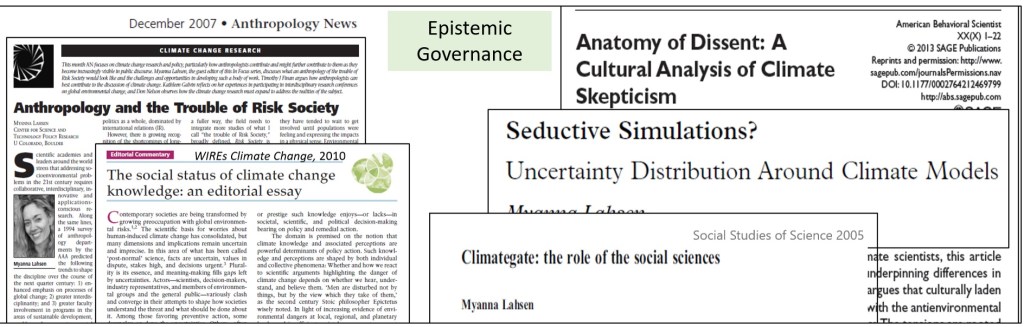
Lahsen, M. “Anatomy of Dissent: A Cultural Analysis of Climate Skepticism.” American Behavioral Scientist 57(6):732-53. DOI: 10.1177/0002764212469799. Online pre-publication 10 January 2013.
Based on ethnographic analysis of US climate scientists, this article identifies largely unrecognized socio-cultural dimensions underpinning differences in scientists’ perceptions of anthropogenic climate change. I argue that culturally laden tensions among scientists have influenced some to engage with the anti-environmental movement and, as such, influence US climate science politics. The tensions are rooted in broad-based and on-going changes within US science and society since the 1960s and propelled by specific scientific subgroups’ negative experiences of the rise of environmentalism and of climate modeling, in particular. Attending to these and other experience-based cultural dynamics can help refine cultural theory and enhance understanding of the deeper battles of meaning that propel climate science politics. The book chapter (first listed) has additional ethnographic discussion.
Lahsen, M. “Climategate: The Role of the Social Sciences.” Climatic Change, 119(3):547-58, 2013. DOI: 10.1007/s10584-013-0711-x, Published online 6 March 2013.
As has been widely documented, the lavishly funded media campaigns by political and financial elites and corporations with vested interests against climate policy are a central instigator of the climate backlash and a threat to democratic processes. However, it would behoove the environmental coalition, including sympathizing academics, to reflect on how they help create conditions that enable and magnify the impact of the backlash campaigns and incidents such as Climategate. This editorial argues that common, idealized understandings of science increase public vulnerability to backlash campaigns. Academic analysts reinforce these understandings through tendencies towards idealized representations of climate science and associated politics, and through avoidance of critical analyses of the science and scientists promoting concern about climate change.
Jessica Barnes, Michael Dove, Myanna Lahsen, Andrew Mathews, Pamela McElwee, Rod McIntosh, Frances Moore, Jessica O’Reilly, Benjamin Orlove, Rajindra Puri, Harvey Weiss, and Karina Yager. “Contribution of anthropology to the study of climate change.” Nature Climate Change 3(6): 541, 2013.
Understanding the challenge that climate change poses and crafting appropriate adaptation and mitigation mechanisms requires input from a range of perspectives across the natural and social sciences. Anthropology’s in-depth fieldwork methodology, long engagement in questions of society-environment interactions, and broad, holistic view of society yield valuable insights into the science, impacts, and policy of climate change. Yet the discipline’s voice in climate change debates has remained a relatively marginal one up till now. Here, we identify three key ways in which anthropological research can enrich and deepen contemporary understandings of climate change.
M. Lahsen, M. M.C. Bustamante, R. Swap,E. McNie, J. P.H. B. Ometto, T. Schor, H. Tiessen, S. Andelman,H. J.Annegarn. 2013.“The Contributions of Regional Knowledge Networks Researching Environmental Changes in Latin America And Africa: A Synthesis of What They Can Do and Why They Can Be Policy Relevant.” Ecology and Society 18(3):14. Special Feature on “Bridging Conservation and Development in Latin America and Africa.”
This paper provides a synthesis of what regional scientific research networks in less developed regions of the world can do and why they might be relevant for societal decisions and practice. It does so through a focus on three regional science network initiatives which aim to enhance understanding of the multi-scalar dynamics of global environmental change (GEC) regionally and globally, namely the Southern Africa Regional Science Initiative (SAFARI-2000), the Large-Scale Biosphere-Atmosphere Experiment in Amazonia (LBA), and the Inter-American Institute for Global Change (IAI). With view to aiding future efforts at regional research network formation, it assesses whether and how these three networks enhanced regional science, and the extent to which they sought and managed to bridge the science-policy gap that challenges GEC science as a whole. Identifying key decisions and attributes bearing on their successes, the analysis attends specifically to how the three networks sought to build capacity, how differences and similarities between them affected their level of autonomy from governments, and how this and other factors influenced their functioning and achievements.
M. Lahsen, R. Sanchez, P. Romero Lankao, P. Dube, R. Leemans, M. Mirza, P. Pinho, B. Elasha, M. Stafford Smith. 2010. “Impacts, Adaptation and Vulnerability to Global Environmental Change: Challenges and Pathways for an Action-Oriented Research Agenda for Middle- and Low-Income Countries.” Current Opinion in Environmental Sustainability 2: 1-11.
Research on climate-related societal vulnerability, impacts, and adaptation (VIA) options is currently underdeveloped, prompting international global environmental change (GEC) research institutions to hold a series of meetings in 2009-2010. This article relates some key findings and recommendations that emerged from one of these meetings, a workshop in Brazil specifically aimed at identifying VIA research, researchers, and knowledge needs in low- and middle-income countries. The socio-economic impacts of environmental stresses associated with GEC depend on how societies organize themselves. Effective responses to the challenge of reducing vulnerability and enhancing adaptation will drive research and policy into difficult, if not entirely new, areas of research. Aside from greater understanding of indirect, societal effects of GEC, governance issues need to become central objects of empirically-based, detailed, multi-scalar and action-oriented research. Such research needs to address the politically sensitive and seemingly intractable issue of reducing global inequities in power and resource distribution, and to include analysis of crucially important but “messy”, “intangible”, and difficult to predict factors such as values, interests, and meaning-making. The scientific literature suggests that without effective action in those directions, current trends towards greater inequality will continue to both reflect and intensify global environmental threats and their impacts.
Lahsen, M. “The Social Status of Climate Knowledge,” WIREs Climate Change, Volume 1, No. 2, 2010, 162 – 171. DOI: 10.1002/wcc.27. Accessible at: http://wires.wiley.com/WileyCDA/WiresArticle/wisId-WCC27.html
This editorial in the new international review journal WIRE: Climatic Change argues that the social status of climate change knowledge must be an essential part of climate research, and characterizes the state of this area of scholarship. Through a discussion of the differentiated orientations and contributions of a range of disciplines, it identifies obstacles limiting research on the social status of climate change knowledge as well as promising pathways. The discussion highlights the need for interdisciplinary approaches in order to capture the multiple scales, dimensions, and dynamics of the complex socio-political dynamics that shape understandings of the problem of human-induced climate change.
Lahsen, M. “A science–policy interface in the global south: The politics of carbon sinks and science in Brazil,” Climatic Change, Vol. 97, Issue 3, 2009, p. 339 (DOI 10.1007/s10584-009-9610-6).
Focusing on the uptake of politically consequential scientific arguments as to whether or not the Amazon is an overall carbon sink (i.e. absorbs atmospheric carbon), the paper reveals important divergences in interpretations on this issue among scientists at the international level and within Brazil. European-led empirical research in the Amazon initially showed the undisturbed Amazon to be a large sink. European scientists participating in the LBA modified downwards these earlier estimates, but they still tend to find the Amazon to be a sink. American LBA scientists, by contrast, are inclined to be skeptical of these findings. Brazilian scientists are divided between the two views. Backed by prominent Brazilian scientists, however, the Brazilian media have privileged scientific views and evidence suggesting that the Amazon forest is a carbon sink. The paper presents evidence of this pattern and shows that powerful Brazilian decision makers, by contrast, have proven resistant to this “pro-sink” argument. It concludes that decision makers’ resistance to this particular scientific interpretation is supported by uncertainties characterizing present understanding of the global carbon cycle but that it also reflects features of national political culture, in particular prominent, national-level understandings of the Amazon, interpretations of Brazilian interests in international politics related to human-induced climate change, and long-standing tendencies in Brazilian environmental policymaking. Thus rendering evident the importance of national and regional political cultures in the absorption of scientific information, it concludes that policy advances in the area of global environmental problems at times depend less on additional scientific research than on more thorough understanding of the internal struggles and the cultural and political particularities that characterize the interpretive frameworks, the struggles, and the traditions bearing on policy formation in countries and regions with leverage in global environmental politics.
Lahsen, M. “Knowledge, democracy and uneven playing fields: Insights from climate politics in – and between – the U.S. and Brazil.” Book chapter in Knowledge and Democracy: A 21st-Century Perspective, ed. Nico Stehr. London: Transaction Publishers, 2008, pp. 163-181.
This article reflects on the relationship between techno-science and democracy through examples of climate politics in – and between – the United States and Brazil bearing on the principles of equity and participation in decision-making central to conceptions of democracy. The analysis draws on extensive ethnographic research on the production, distribution and use of global change science in these two country settings. Identifying the enduring advantage enjoyed by those with greater financial and political resources when it comes to the production and mobilization of knowledge, at the national level and the level of geopolitics, the examples discussed illustrate the depth of the challenges represented by the increasing role of science in politics in a context of great, and increasing, economic inequity at both national and international levels.
Lahsen, M. “Experiences of modernity in the greenhouse: A cultural analysis of a physicist ‘trio’ supporting the conservative backlash against global warming.” Global Environmental Change (2008), Vol. 18(1): 204-219.
In the context of President George W. Bush’s rejection of the Kyoto Protocol intended to combat human-induced climate change, it appears important to improve understanding of powerful efforts to reframe global climate change as a non-problem. This paper draws on ethnographic research among U.S. scientists involved with climate science and politics to improve understanding of the U.S. controversy over global climate change by attending to structuring cultural and historical dimensions. The paper explores why a key subset of scientists – the physicist founders and leaders of the George C. Marshall Institute – chose to lend their scientific authority to the “environmental backlash,” the counter-movement that has mobilized to defuse widespread concern about perceived environmental threats, including human-induced climate change. The paper suggests that the physicists joined the backlash to stem changing tides in science and society and to defend their preferred understandings of science, modernity, and of themselves as a physicist elite – understandings challenged by recent transformations in American science and society that express themselves, among other places, in the widespread concern about human-induced climate change.
Carlos A. Nobre, M. Lahsen and Jean P. Ometto. 2008. “Global Environmental Change Research: Empowering Developing Countries.” Annals of the Brazilian Academy of Sciences, 80(2): 1-7.
This paper discusses ways to reconcile the United Nations Millennium Development Goals with environmental sustainability at the national and international levels. The authors argue that development and better use of sustainability relevant knowledge is key, and that this requires capacity building globally, and especially in the less developed regions of the world. Also essential is stronger integration of high-quality knowledge creation and technology- and policy-development, including, importantly, the creation of centers of excellence in developing regions which effectively use and produce applications-directed, high-quality research and bring it to bear on decision making and practices linked to environmental change and sustainable management of natural resources. The authors argue that such Southern centers of excellence are a necessary first step for bottom-up societal transformation towards sustainability, and that such centers must help design innovative ways to assess and place value on ecosystem services.
Lahsen, M. “The Challenge of Connecting International Science and Local Level Sustainability: The Case of the LBA.” First author (second author, Carlos A. Nobre). Environmental Science and Policy10 (1), 2007, pp. 62-74.
This article uses an international environmental science experiment in the Amazon as a case study in issues that can arise when doing globally oriented research in a less developed country setting, and a test of assumptions that such research benefits global and local levels simultaneously. The article performs a qualitative evaluation of the extent to which the Large-Scale Biosphere experiment (LBA) has achieved its goals related to ecosystem sustainability in the Amazon region, identifying structural obstacles within science that must be overcome to improve the fit between international science programs and efforts to nurture more sustainable use of natural resources in a less developed country. It concludes that the LBA has been a valuable investment by standard measures (esp. scientific publications and capacity building) and has performed weakest in the area of “sustainability science,” despite its stated goal to support ecosystem sustainability in the Amazon. Data presented suggests that cultural, institutional and political reasons explain this weakness, including the professional, normative and experiential backgrounds of the program’s planners, the norm-based incentive structures to which they are subjected, and the interests and institutional mandate of its Northern funders and scientists. The most central obstacle is the fact that sustainability science challenges long-standing, institutionalized practices and normative frameworks that structure the organization of science in the North as in the South, from how scientists select, plan, execute and communicate their own research to how they evaluate the work of others and think about the relationship between science and societal problems. Increasing the relevance of scientific research for sustainability in the Amazon thus depends on changes at these levels as well as the level of curriculum content. At the very least, natural scientists ought to be encouraged to think more about the applications of their research and how they might reshape institutional structures to maximize societal and environmental benefits also of science projects propelled by scientists’ academic interests.
Lahsen,M. 2007.“Trust through participation? Problems of knowledge in climate decision making.” Book chapter in The Social Construction of Climate Change: Power, Knowledge, Norms, Discourses, edited by Mary Pettinger. Ashgate Publishing, 2007.
This book chapter probes answers to the following questions: To what extent do suspicions related to science exist and shape global environmental politics? To what extent are their systemic causes known, including the role played by global inequalities in scientific capacity and power? To what extent do participation and scientific capacity reduce suspicions, to the extent that any such exist? On the basis of data and observations derived from review of scholarly literature and from years of empirical research among Brazilian environmental scientists and decision makers responsible for Brazil’s foreign policy related to human-induced climate change, it discusses indications of distrust related to scientific knowledge underpinning international environmental negotiations, as evidenced especially on the part of less developed country leaders. The paper argues that the role of such inter-subjective factors in global environmental politics needs to be better understood, and relates this knowledge gap to broader tendencies in the field of international relations and beyond. The conclusion offers some thoughts about how to fill the gap.
Lahsen, M. “Anthropology and the trouble of risk society,” Anthropology News, Vol. 48, No. 9, December 2007, pp. 9-10.
Evaluates the actual and potential contributions of the field of anthropology in global environmental change research, identifying transformations of the field needed if it is to contribute more centrally in this area of research, to mutual benefit.
Lahsen, M. “Technocracy, democracy, and U.S. climate politics: The need for demarcations” Article published in Science, Technology, and Human Values Vol. 30, No. 1 (Winter 2005), pp. 137-169.
Ulrich Beck and other theorists of reflexive modernization are allies in the general project to reduce technocracy and elitism by rendering decision making more democratic and robust. However, this study of U.S. climate politics reveals complexities and obstacles to the sort of democratized decision making envisioned by such theorists. Since the early 1990s, the U.S. public has been subjected to numerous media-driven campaigns shaping understandings of this widely perceived threat. Political interests have instigated an important part of these campaigns, frequently resorting to ethically problematic tactics to undermine attempts at policy action designed to avert or reduce the threat. The disproportionate influence of such interests suggests the need for a more level political playing field characterized by more equalized access to power and influence.
Lahsen, M. 2005. “Seductive simulations? Uncertainty distribution around climate models” Social Studies of Science 35 (Dec.): 895-922.
This paper discusses the distribution of certainty around General Circulation Models (GCMs) – computer models used to project possible global climatic changes due to human emissions of greenhouse gases. It calls for a multi-dimensional and dynamic conceptualization of how uncertainty is distributed around this technology. Processes and dynamics associated with GCM modeling challenge the common assumption in science studies and beyond that producers of a given technology and its products are the best judges of their accuracy. Drawing on participant observation and interviews with climate modelers and the atmospheric scientists with whom they interact, the study analyzers the political dimensions of how modelers talk and think about their models, suggesting that modelers sometimes are less able than some users to identify shortcomings of their models.
Lahsen, M. 2004. “Transnational locals: Brazilian scientists in the climate regime.” Book chapter in Earthly Politics, Worldly Knowledge: Local and Global in Environmental Politics edited by Sheila Jasanoff and Marybeth Long-Martello. MIT Press.
This book chapter builds on and extends critiques of the epistemic community framework that have emerged from the field of science and technology studies and which suggest that support for a shared perception of environmental problems may be the result of diverse social and political influences, including shared disciplinary orientations, economic interests, political ideologies or discursive framings. Through an ethnographic study of Brazilian scientists and policymakers engaged with international climate science and politics, the chapter identifies uncharted ideological and political minefields encountered in efforts to find common ground on a planetary scale concerning the global environment. Data presented suggests that members of the “climate epistemic community” in Brazil have far more complex identities, more agency, more ambivalence, and more selective allegiances to the climate “episteme” than assumed by epistemic community scholars.
Lahsen, M. “The detection and attribution of conspiracies: The controversy over [the IPCC’s] Chapter 8.” In Marcus, G.E. (1999) Paranoia within reason: A casebook on conspiracy as explanation. University of Chicago Press.
Analysis of the nature and origins of mass media-powered conspiracy theories surrounding Chapter 8 of the United Nations 1995 Intergovernmental Panel on Climate Change (IPCC) assessment of science identifying the “human fingerprint” in climate records. It highlights the role of public relations campaigns and industry groups and political groups representing the extreme right. It shows how trust also operates among environmental coalition members to allow circulation of unverified claims and highlights the role of conflicting interests and views concerning what kind of society and future are desired.
 Myanna Lahsen